
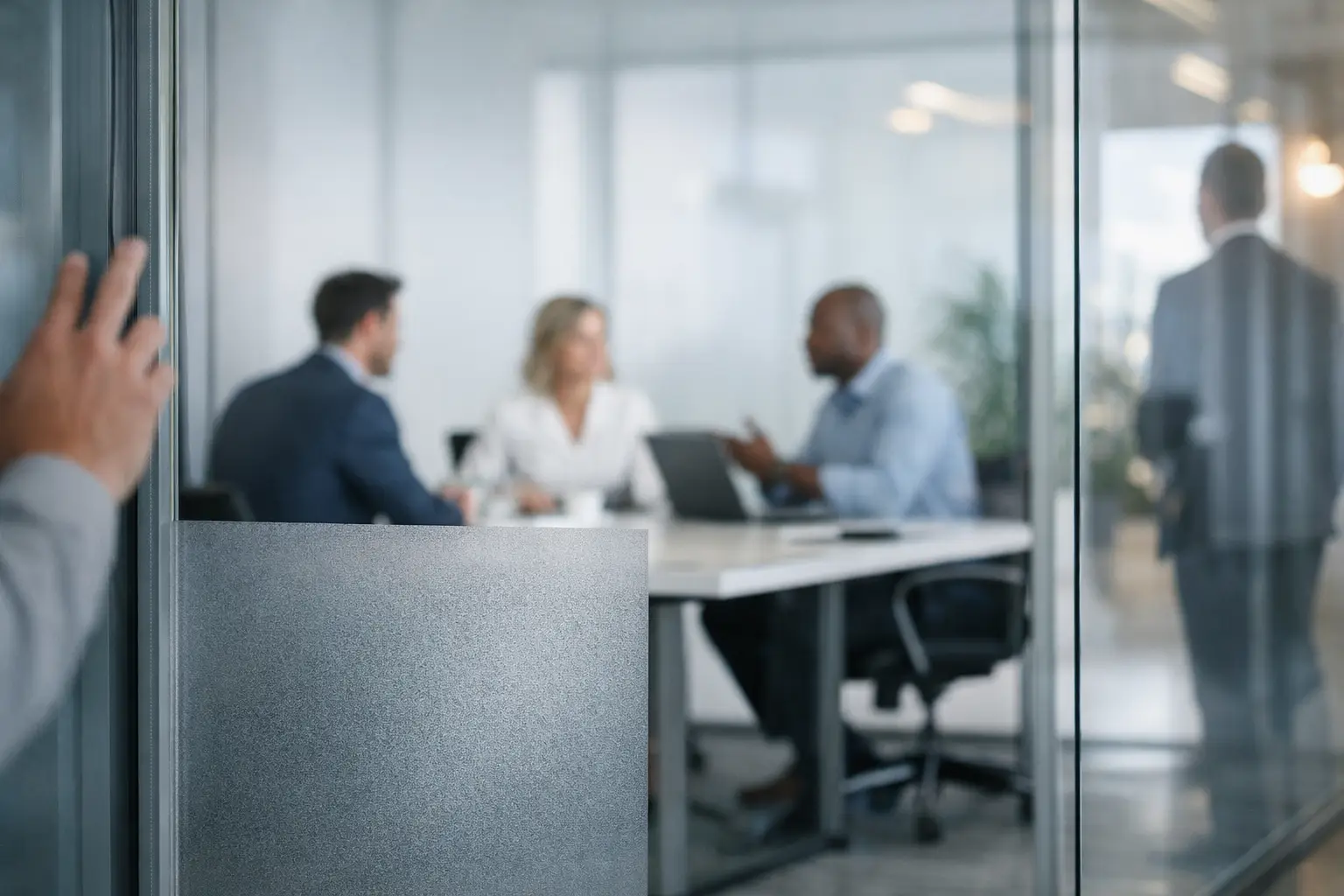
A confidential client call should not be audible from the corridor. A performance review should not feel exposed to the people at nearby desks. When these moments happen in a room that looks polished but allows every word to travel, the workplace loses more than comfort. It loses trust. To improve meeting room privacy, businesses need to consider acoustics, layout, glazing, access, and visual control as one coordinated design decision.
For Dubai offices, where open-plan layouts and glass-fronted meeting rooms are common, privacy requires particular care. The goal is not to make every room closed off or heavy. It is to create focused, professional environments where teams can speak freely while the workplace still feels open, modern, and connected.
Why Meeting Room Privacy Affects Business Performance
Meeting rooms are used for far more than routine updates. They host strategy conversations, commercial negotiations, HR discussions, board meetings, investor calls, interviews, and sensitive conversations with clients. If speech is clearly heard outside the room, employees may withhold information, clients may question discretion, and leaders may avoid using a space that should support important decisions.
Visual privacy matters as well. A room facing a reception area, circulation path, or adjacent workstations can put people on display. Even when a conversation cannot be heard, visible documents, screens, body language, and meetings involving senior visitors can create unnecessary exposure.
A well-designed privacy strategy supports concentration and demonstrates a professional standard of care. It tells employees and visitors that the organization has planned its workplace around how people actually work, not simply how the space looks in photographs.
Improve Meeting Room Privacy Through Better Planning
Privacy begins before materials are selected. The location of the meeting room within the floor plan often has the greatest influence on its performance. Placing a room directly beside a busy pantry, reception desk, printer zone, or collaborative lounge creates a constant source of disruption. A more protected location, away from the noisiest circulation routes, gives the room a stronger foundation.
Consider the types of conversations each room will host. A small room intended for quick team check-ins does not need the same acoustic specification as an executive boardroom or HR interview room. Matching the level of privacy to the room’s function helps control fit-out costs without compromising on the spaces where confidentiality is essential.
Door placement also deserves attention. A door opening directly toward desks or a public corridor can expose attendees as they enter and leave. A short vestibule, recessed entrance, or carefully positioned partition can make access feel more discreet. In compact offices, even a modest change to the approach of a room can improve both privacy and perceived quality.
Separate Quiet Rooms From Active Zones
Open offices benefit from clear activity zoning. Put social, collaborative, and high-traffic functions together where practical, then locate rooms for confidential meetings in quieter zones. This approach reduces the amount of acoustic treatment required later and creates a more intuitive workplace experience.
It also helps to avoid grouping every meeting room in one highly visible central bank. Some businesses need a prominent client-facing boardroom, while others benefit from smaller private rooms placed closer to leadership or department teams. The right arrangement depends on visitor flow, team structure, and the daily rhythm of the office.
Control Sound, Not Just Noise
Many offices try to solve privacy by adding soft furnishings after the fit-out is complete. Rugs, curtains, and acoustic panels can reduce echo inside a room, which makes meetings more comfortable. However, they do not automatically stop speech from passing through walls, ceilings, doors, or gaps around services.
Sound absorption and sound insulation are related but different. Absorption reduces reverberation within a space. Insulation limits sound transfer between spaces. A meeting room needs both when confidential speech is a priority.
High-performance walls should extend to the structural slab above the ceiling where possible. If a partition stops at a suspended ceiling, sound can travel over the top and into adjacent rooms. Properly sealed joints, acoustic insulation within wall cavities, and attention to electrical boxes and service openings are equally important. One unsealed penetration can weaken an otherwise well-built partition.
Doors are frequently the weakest point. A lightweight hollow-core door with visible gaps at the edges will allow speech to escape, regardless of how carefully the walls are designed. Solid-core or acoustic-rated doors, perimeter seals, automatic door bottoms, and quality hardware provide a noticeable improvement. Door closers should be adjusted so the door shuts fully without slamming.
Use Ceiling Design Carefully
Open ceilings can create a striking contemporary look, but they make speech privacy more difficult to achieve. In spaces requiring confidential discussion, a closed ceiling system with appropriate acoustic backing may be the better choice. If an exposed ceiling is central to the design vision, the meeting room enclosure must be detailed to maintain acoustic continuity around ducts, cable trays, and other services.
Mechanical systems also need careful coordination. Loud air-conditioning can affect speech clarity inside the room, while oversized grilles or unlined ductwork can carry voices to nearby areas. Experienced fit-out planning coordinates HVAC, electrical, and partition works early, rather than treating privacy as an issue to solve after installation.
Balance Transparency With Visual Privacy
Glass partitions bring daylight deep into an office and help spaces feel larger. They are also a strong fit for modern corporate interiors, particularly when a business wants a refined and transparent culture. Yet clear glass can make private meetings feel exposed, even when the acoustic performance is adequate.
There are several ways to retain the benefits of glazing without sacrificing discretion. Frosted film or a gradient finish can conceal seated attendees while preserving light. Fluted or textured glass introduces a more decorative, hospitality-inspired character and softens views from outside. Integrated blinds provide flexibility for presentations, interviews, and leadership meetings that require more control.
Switchable privacy glass is a premium option for executive rooms, client presentation spaces, and multipurpose areas. At the touch of a control, the glazing changes from transparent to opaque. It offers a clean appearance and immediate visual separation, although it requires a higher upfront investment and coordination with electrical works.
The best choice depends on the role of the room. A client-facing boardroom may benefit from clear glass with integrated blinds, while a human resources room may need more permanent obscurity. Design should reflect function rather than apply one partition style across the entire office.
Add Speech Masking Where It Makes Sense
Sound masking introduces a low, consistent background sound that makes nearby speech less intelligible. It can be useful in open work areas outside meeting rooms, particularly where teams sit close to glazed partitions or shared circulation routes.
It is not a replacement for well-constructed walls and sealed doors. If sound is freely leaking through an enclosure, masking will not provide the level of confidentiality needed for legal, financial, or HR discussions. It is best used as an added layer in a larger acoustic strategy.
For organizations with highly sensitive conversations, consider a simple privacy test before final handover. Have one person speak at a normal meeting volume inside the room while another listens from the adjacent space. Test at the door, the partition line, ceiling edges, and nearby workstations. This practical check often identifies gaps that are easy to correct before the office is occupied.
Design Details That Support Discretion
Privacy is also influenced by the small details employees notice every day. Position screens so they do not face transparent walls. Provide cable management and concealed power points so confidential documents and devices can be used without clutter. Choose window treatments that can be adjusted easily, rather than options employees will avoid because they are difficult to operate.
Booking systems can help prevent inappropriate room use. A small, acoustically private room should not be occupied for a casual two-person catch-up while an HR manager is forced to use a visually exposed space. Clear room naming, capacity guidance, and booking rules make the office work more effectively without adding more square footage.
Furniture selection matters too. High-backed lounge seating outside a meeting room can create informal acoustic shelter, while a crowded waiting area directly outside the door can undermine privacy. In boardrooms, upholstered chairs, acoustic wall finishes, and well-proportioned tables help reduce internal echo and allow participants to speak at a natural volume.
A Privacy Strategy Should Fit the Whole Office
The strongest results come from treating privacy as part of the full office design, not as a single product purchase. A beautiful glass partition system, for example, may need acoustic seals, insulated solid walls, a better door, frosted zones, and revised furniture placement to perform as intended. The right solution is always shaped by the office layout, budget, brand image, and level of confidentiality required.
Al Sahm Decoration Design approaches office fit-out projects with this complete perspective, combining space planning, partition design, material selection, and execution quality to create workplaces that feel both open and protected. A detailed site assessment can identify where sound and sightlines are creating risk before renovation work begins.
The most effective meeting rooms are not necessarily the most closed-in rooms. They are the rooms where people can speak candidly, focus fully, and leave confident that the conversation stayed where it belonged.


